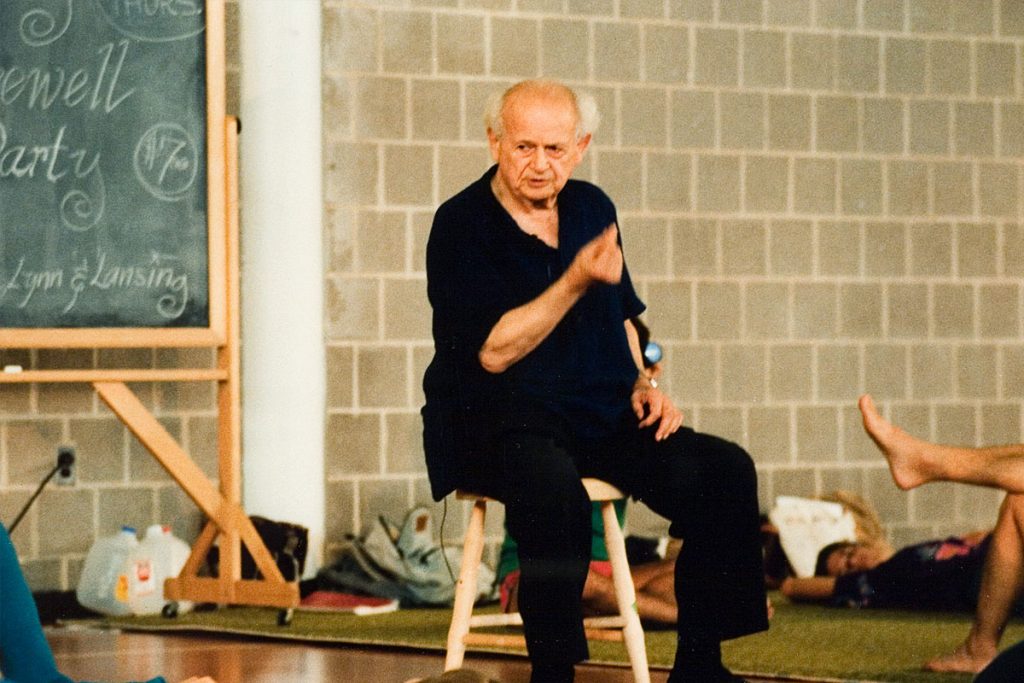
Moshe Feldenkrais hält einen Vortrag

“What I’m after isn’t flexible bodies but flexible brains. What I’m after is to restore each person to their human dignity”
What I’m after is to restore each person to their human dignity.“
– Moshe Feldenkrais

Moshe Feldenkrais was an engineer, physicist and martial artist. Born in 1904 in Ukraine, he made Aliyah alone at the age of 15, fleeing to Eretz Israel to escape the Russian pogroms. Feldenkrais lived in Tel Aviv until 1930 where he helped to build up the city as a construction worker and later as a teacher and a surveyor. During this time he translated the book “The Practice of Autosuggestion” by Emile Couè into Hebrew, and as well as writing one of his own about his experiences in the Haganah. Feldenkrais learned Jiu Jitsu in street fights in Tel Aviv, developing his own sequences of movements that reflected the fact, that Jews were not allowed to carry any weapons at the time but were attacked a lot by Arabs in knife combats. His book “Jiu Jitsu ve Haganah Atzmit” was published in 1931. Later while studying engineering at Sorbonne University in Paris, he met Jigoro Kano, the founder of Judo. Kano opened several doors for Moshe Feldenkrais, and upon Kano’s request he became the Ambassador for Judo in Paris. He took lessons, opened a Judo class and wrote several books on the subject – all of which became bestsellers. In 1940 Moshe Feldenkrais again had to flee, this time from the German invasion of France. He went to England and worked as a scientist in the field of submarine research. Here he injured his knee for the second time, this time so badly that doctors threatened him with amputation. Feldenkrais refused to take the chances and responded, however, with the development of his own method.

He gave lectures and courses, and in 1949 he published “Body and Mature Behaviour”.

Feldenkrais went back to Tel Aviv to continue to work with his method. Among other things, he presented lectures on the IDF Radio and opened his own studio in Alexander Yanai Street.

In 1953 he met Ben Gurion, helping him with his severe back pain and going on to teach the man in his late sixties to do a headstand. Photos of the Prime Minister of Israel standing on his head on the Tel Aviv Beach were spread around the world.

In 1971 he began teaching in the USA as well, first in New York, then later in San Francisco and Amherst.

Moshe Feldenkrais died in 1984. He left us with a such tremendous abundance of material that even very trained and skilled practitioners continue to be inspired by it.

May the source of this wisdom never run dry and may the joy of learning accompany us until for the time being.

„Feldenkrais embodied the Jewish tradition of asking questions – and answering a question by asking another one.“
– A Life in Movement – Mark Reese
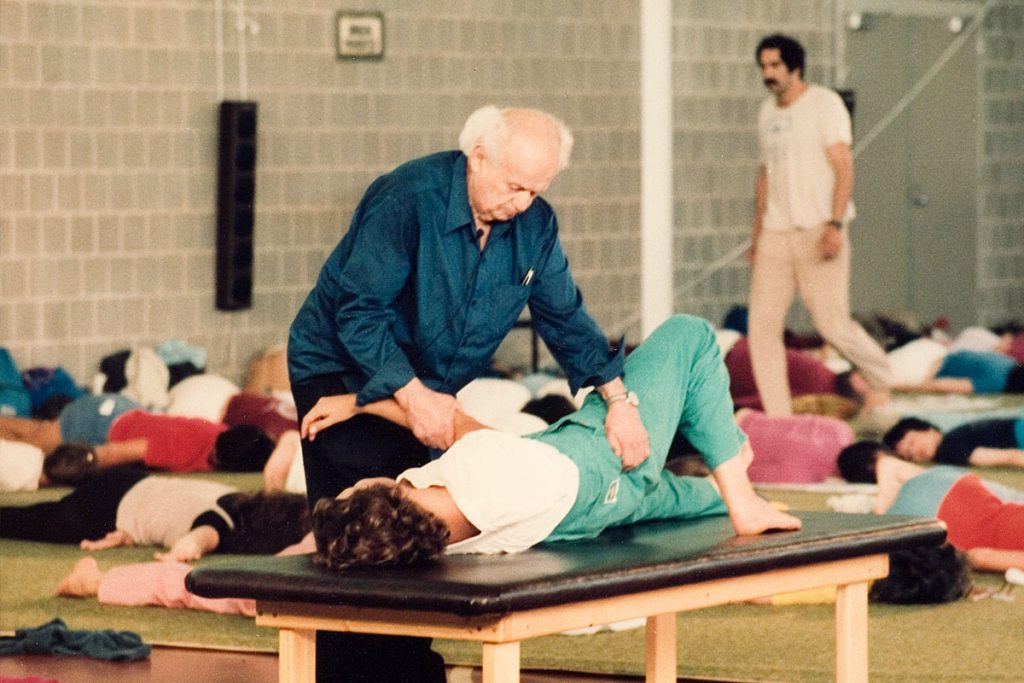
Moshe Feldenkrais praktiziert seine Methode an einer liegenden Person
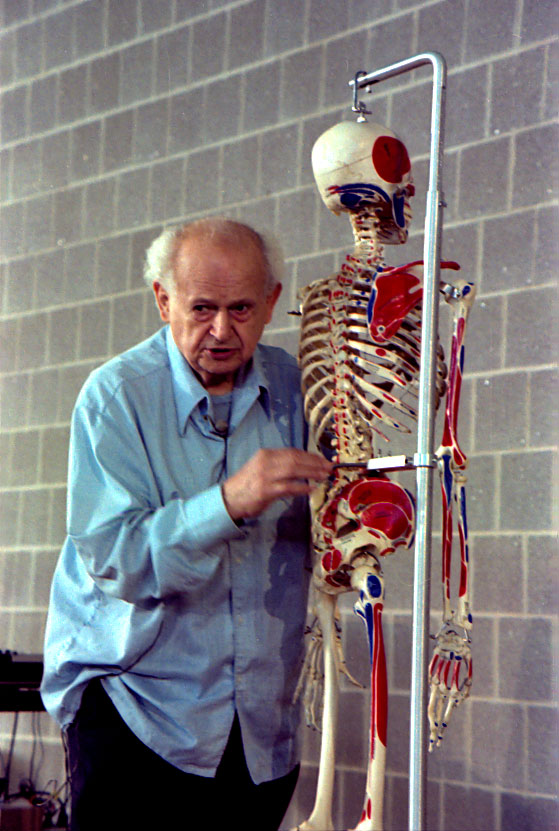
Moshe Feldenkrais erklärt mit Hilfe eines Skeletts